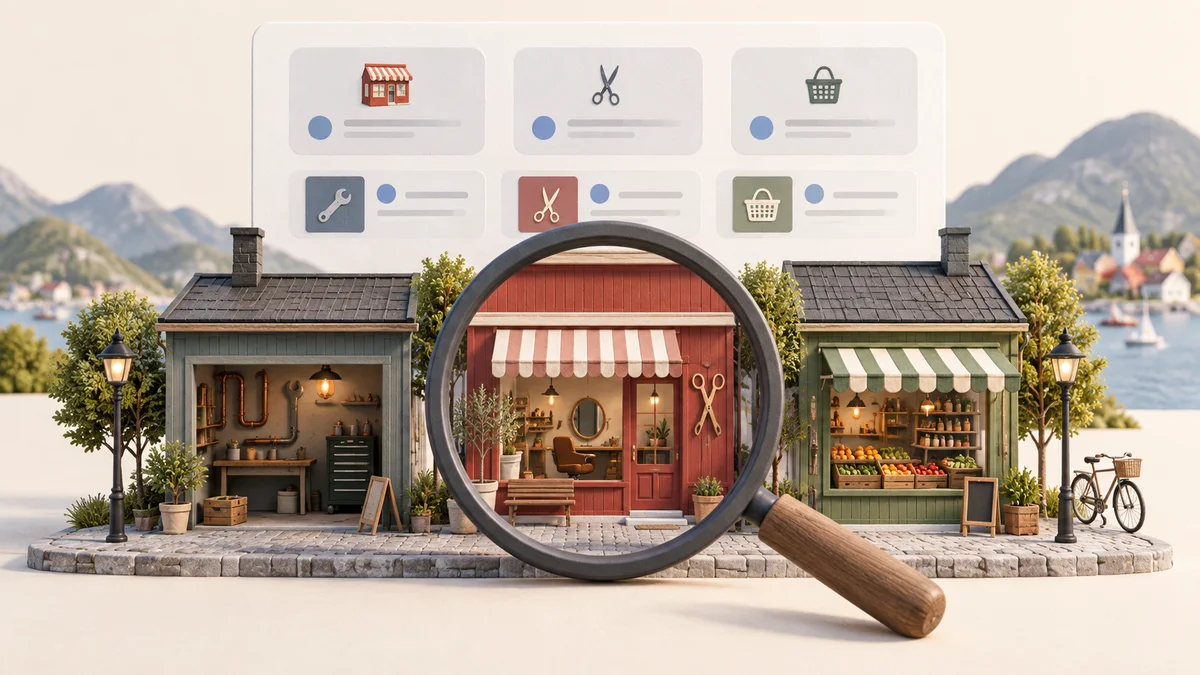
Search for a plumber in Oslo and Google may now show two boxes: one for directories, one for the businesses themselves. For the second box, Google says your website is all it needs. So check what your website says.
What changed
Google has added two new result boxes for searchers in the European Economic Area. Norway is in the EEA, so this applies to searches made here.
The first is what Google calls the aggregator unit. It is filled by approved directories, comparison sites and booking platforms. Only one directory is shown at a time, and clicks go to that directory's site, not to you.
The second is the supplier unit. It is for what Google calls direct providers: an individual hotel, a shop with a physical address, or, in Google's own example, a plumbing business. It only appears when the directory box appears.
The boxes started with hotels, flights, long-distance trains and buses, and products. On 18 September 2026 Google updated both documentation pages to add local businesses, as Search Engine Journal reported. That is the change that matters to a salon in Bergen or an electrician in Drammen.
Google's pages do not say why. Search Engine Journal links the redesign to the EU's Digital Markets Act. That law is not yet part of the EEA Agreement, but Google has chosen to show the boxes to EEA users anyway, so for a Norwegian business the legal question is academic.
The part that concerns your website
Here is the sentence from Google's documentation that we think every local business owner should read: you do not need to provide any data beyond what Google can reach by crawling your site to appear in the supplier unit.
There is no form to fill in and no feed to set up. Google says feeds can enhance a result, but they are not required. For most small businesses, that means Google's picture of you in this box comes from your website.
That is good news if your site says clearly who you are, what you do and where. It is bad news if the address is only in a footer image, the services are one vague paragraph, and the opening hours were last updated before the pandemic.
What we do not know yet
Google has not said how it chooses which businesses appear in the supplier unit, or how often the boxes will show for local searches. It has not published which directories are approved for the aggregator unit either.
So nobody can promise you a place in the box. What you can do is make sure that when Google looks, it finds a clear, correct answer.
What to check on your website now
These are the basics that make a site easy for Google to read. None of them are new. The supplier unit is one more reason to get them right.
- Your name, address and phone number as real text, not inside an image or a map embed. Use the same spelling everywhere.
- One clear page per main service. "Rørlegger" and "baderomsrenovering" are two services and deserve two pages, each saying where you work.
- Opening hours that are correct, on the site and in your Google Business Profile. A customer who finds two different answers trusts neither.
- Nothing blocking Google. Check that your robots.txt file is not shutting out important pages, and that nothing important sits behind a login.
- Structured data for your business. Google does not mention it for the supplier unit. But
LocalBusinessmarkup is the standard way to tell a search engine your name, address, hours and phone number without ambiguity, and it is a small job on most platforms, including WordPress, Wix and Squarespace.
Do not forget the directories
The directory box is filled from the directories' own data, not from your site. If Gule Sider, 1881 or a booking platform for your trade gets approved, what customers see there is whatever that directory has on file about you.
It costs nothing to claim your listing on the directories you already appear in and make sure the details match your website.
One thing you can do today
Open Google Search Console, paste in the address of your contact page and run the URL Inspection tool. Look at "View crawled page". If your address, phone number and opening hours are not in the text Google sees, they are not there for the supplier unit either.
If you do not use Search Console yet, search for your own trade and town in a private browser window and see what Google shows. Then read your own contact page as if you were a stranger.
If you would rather have someone else look, our free website review checks the same basics and tells you what to fix first.