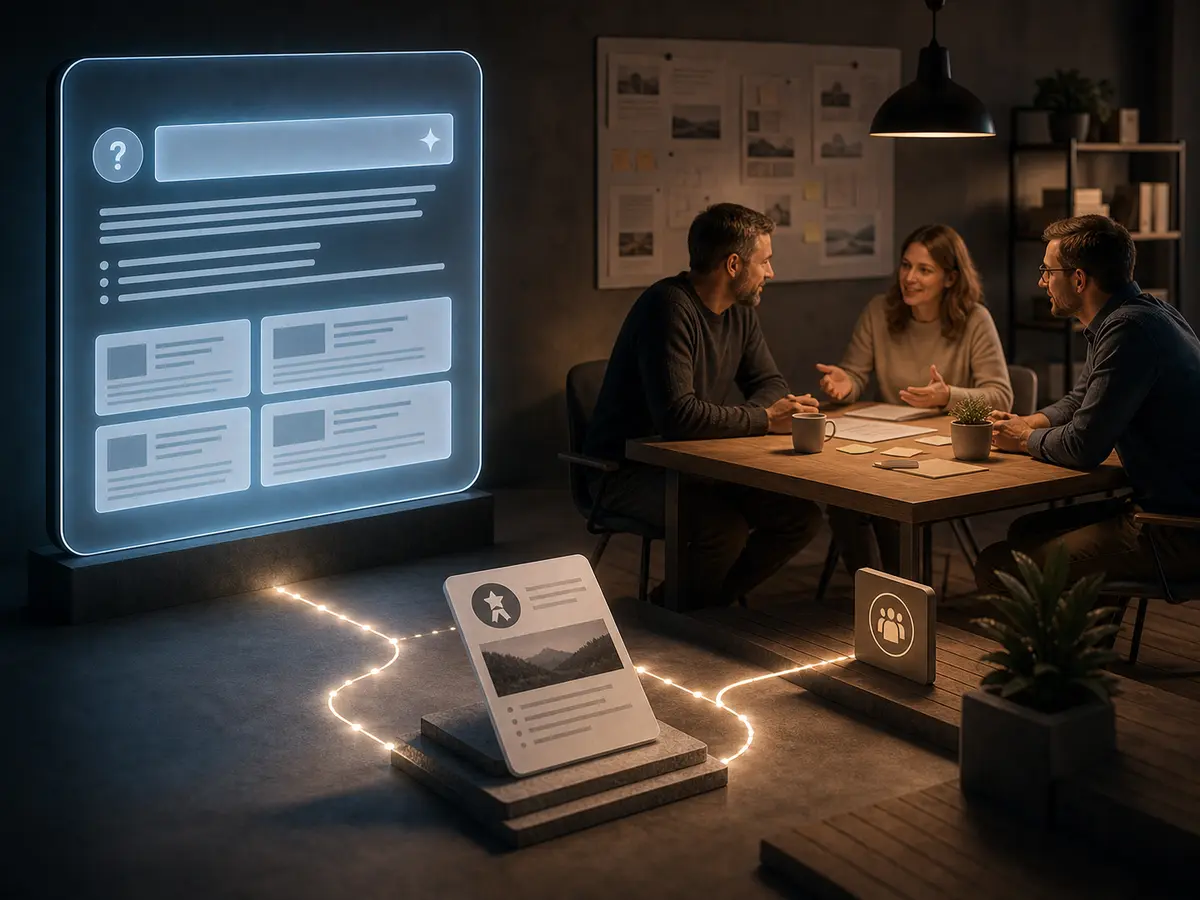
April has made one thing clear for many marketers: Google Search behaves less like a classic discovery engine and more like a task-completion machine.
Users are not necessarily searching to find ten blue links. They search to get the answer, the comparison, the definition, the checklist or the next step. With AI Overviews, much of this is resolved directly on the results page.
For broad, informational searches, this means click-through rates can fall even when rankings look healthy. You can be visible, earn many impressions and still receive fewer visits than before. That is zero-click search in practice.
SEO is not dead, but the old playbook is leaking
When people say "SEO is dead," they usually mean that one type of SEO no longer works as well.
The old model: find a keyword, write a generic article, optimise the title, add some internal links and wait for traffic. That holds up poorly when Google can now summarise the same generic information at the top of the results page. If your content only answers one broad, simple question, an AI Overview can give the user enough that the click never happens.
Visibility is not worthless. But content needs to earn a place in the answer, not just a place below it.
From SEO to GEO
GEO, or Generative Engine Optimization, is about making your brand, expertise and content easier for generative search systems to understand, trust and cite.
It does not replace SEO. It builds on SEO. Technical quality, structure, speed, internal linking, metadata and solid indexation are still the foundation.
But GEO adds one new question: why would an AI-assisted search engine choose your content as a source?
If the answer is "because we wrote the same thing as everyone else," that is not good enough.
Thin content loses its value
Generic blog posts have always been tempting because they are easy to produce. The problem is that they rarely build genuine authority. Content that weakens in a zero-click world:
- Short definition articles with no original insight
- Lists that simply summarise other people's advice
- AI-generated posts with no experience, examples or clear author
- Articles that answer broadly but do not help anyone make a decision
- Content written for volume, not for trust
This content can still be indexed. It can even earn impressions. But it rarely moves the right customers forward.
What should businesses create instead?
Content that is harder to replicate:
- Case studies with a real problem, a real process and a real result
- Your own data, benchmarks, tests and observations
- In-depth explanations written by people with genuine expertise
- Clear service pages that answer the questions customers ask before buying
- Comparisons and decision support for customers weighing their options
- Well-structured content that is easy to cite, summarise and link to
Less "we need a blog post this week," more "what do we know that actually helps the customer?"
Zero-click changes how you measure
Zero-click search makes attribution harder. If people see your brand in AI Overviews, search for you directly later, or convert after multiple touchpoints, the value can be real even without a first click.
Measure more than organic traffic in isolation. Also track:
- Visibility across priority topics
- Branded search and direct traffic
- Conversions from bottom-of-funnel pages
- Lead quality
- Which pages and sources AI systems are actually showing or citing
The future of SEO is not about writing the most. It is about building pages and content that are useful enough to be chosen. Strategy, design, technical SEO and content need to work together: a strong article helps little if the page is slow, and a good service page helps little if it does not answer what the customer is actually wondering about.
Want to make your website more visible in a world of AI Overviews and zero-click search? Get in touch: we will help you build a content strategy that combines classic SEO with GEO: clear structure, genuine authority and content that earns its place as a source.