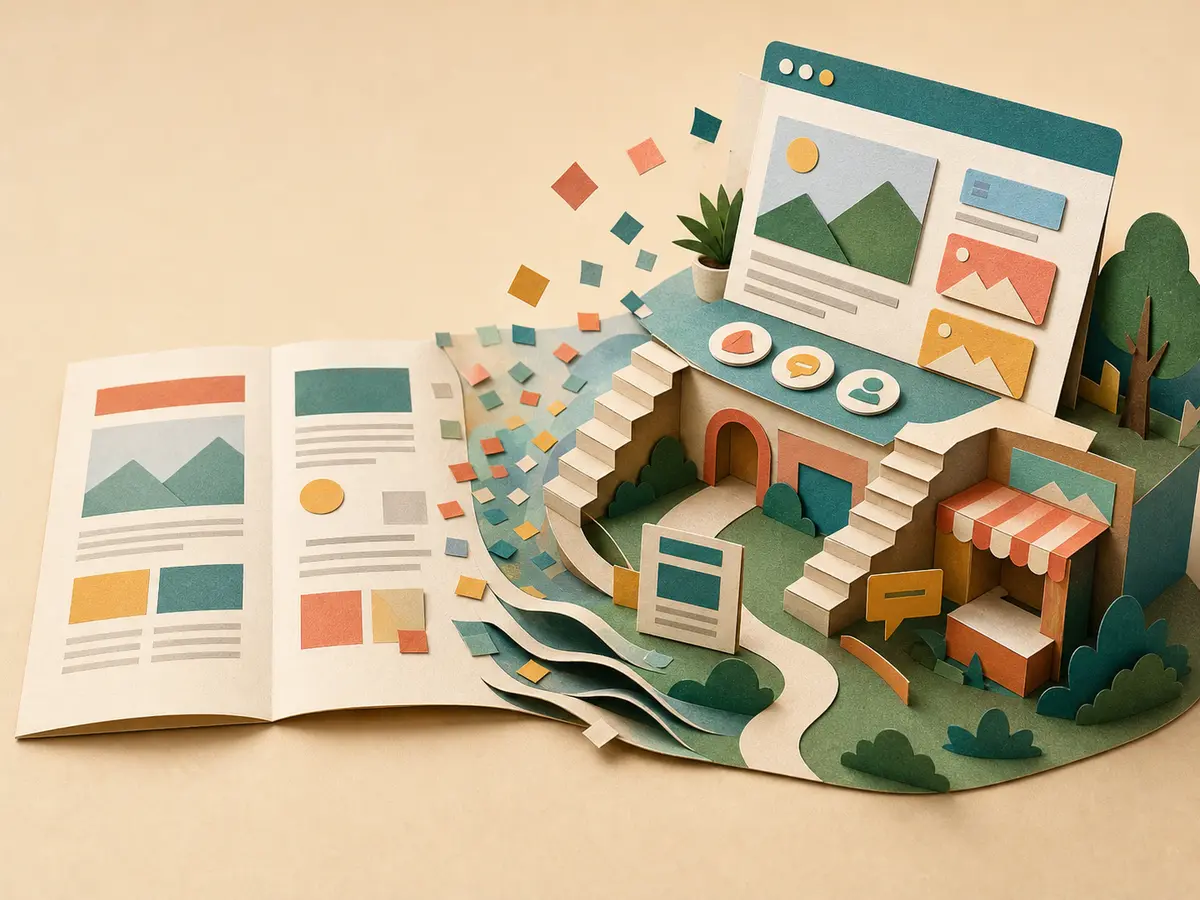
Most small business websites are built from the same template: a homepage with an image and a welcome message, an about page with some company history, a services overview and a contact page with a form.
That is a digital brochure. And a brochure is not a website.
What is the difference?
A brochure informs. It describes what the business offers and presents it in a tidy format. It expects nothing from the reader and does not actively move them forward.
A website should do more. It should help visitors understand whether the offer suits them, build enough trust that they want to get in touch, and make the next step obvious. That requires a different approach to content, structure and design.
The most common mistake: writing about yourself, not the customer
Read through the content on most small business websites and you find a consistent pattern: the content is about the business.
"We were founded in 2009." "We offer a wide range of services." "We are committed to quality and customer satisfaction."
The customer visiting the page is not asking "who are you?" They are asking "can you help me?" Those are two very different questions, and they require very different answers.
A website written around the customer's problem: what they are struggling with, what they want to achieve, what they are uncertain about, reads as more relevant and more credible than one that presents the supplier.
What does it take for a site to actually do the job?
A clear message on the homepage The visitor should understand what you offer, for whom and why it is worth exploring further, before they have scrolled past the first section. Not "welcome to our company", but what can they expect to gain by working with you?
Content that builds trust References, concrete examples, names and faces, results. Not generic claims about quality: specific evidence that you deliver.
A clear next step What do you want the visitor to do? Get in touch? Download something? Call? It should be obvious, and it should be easy. A page without a clear next step is a page that lets customers walk out the back door.
Content that answers the questions customers have Before anyone makes contact, they typically have a series of questions: How much does it cost? Is this suited to a business our size? What is the process? How long does it take? The better your website answers those questions, the shorter the path to an enquiry.
A website is never finished
A brochure is printed and distributed. Then it is done.
A website is a working tool that should be updated, tested and improved over time. What are people clicking on? Where are they dropping off? Which pages lead to contact? The answers to those questions should drive continuous improvement.
For many small businesses, the website is the most important sales channel they have, and the only one that works around the clock. It is worth treating it that way.
Want to know whether your website is doing active work for your business? Get in touch: we will run a review and give you an honest assessment.